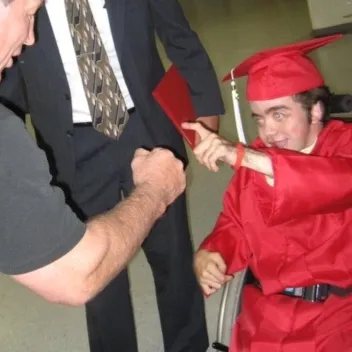
The following is a list of various symptoms and conditions that have been described in patients with Marshall-Smith Syndrome.
Skull
Macrocephaly – head larger than usual
Craniosynostosis – premature closure of skull sutures
Trigonocephaly – early closure of the metopic suture
Thickened calvarium – abnormally thick skull bone
Dolichocephaly – elongated head shape
Wormian bones – growth in skull sutures
Frontal bossing – forehead bone protrudes outward
Large and prominent forehead
Shallow orbits – shallow eye sockets
Midface hypoplasia – undersized bones of the cheeks, nose and upper jaw
Neck & Spine
Abnormal neck extension
Atlantoaxial instability (C1-C2) instability or dislocation
Congenital spinal stenosis – narrowing of space around the spinal cord
Scoliosis – sideways curvature of the spine
Kyphosis – abnormal rounding of the upper back
Kyphoscoliosis – curving of the spine side to side and front to back
Protruding sacrum/coccyx
Hands & Feet
Large, distinct hands
Bullet-shaped middle fingers
Proximal insertion of thumb – thumb is set lower on the hand
Distal widening of the metacarpals
Clinodactyly of the 5th finger – pinky finger turns inward
Prominent finger and toe pads
Hallux valgus – big toe points inward
Hammer toe – flexion of the great toes
Deep crease between big toe and second toe
Overlapping toes – toes bunch together as if crowded
Hypoplastic nails – hypoplastic fingernails and toenails
Long, slender feet
Miscellaneous Musculoskeletal
Hypotonia – low muscle tone throughout the body
Accelerated skeletal maturation
Recurrent fractures
Osteopenia / Osteoporosis – decreased bone density
Asymmetrical rib cage, narrower at the top
Large sternal ossification centers
Pectus excavatum or Pectus carinatum – sternum is sunken in or protruding
Abdominal hernia (umbilical, specifically)
Decreased hip abduction
Hip dysplasia – shallow hip sockets
Coxa vara – abnormal shape of femoral neck
Bowing of the long bones
Slender bones
Tibial torsion – abnormal rotation in lower leg
Short adult stature
Airway
Airway obstruction, anatomical
Laryngomalacia – floppy tissue in back of throat
Tracheomalacia – floppy tissue in trachea
Stridor – high-pitched sound heard upon inhale
Atelectasis – collapse of the air sacs in the lungs
Acute respiratory distress syndrome
Hypoxia – insufficient blood oxygen levels
Hypercapnia – levels of CO2 are too high
Hypopnea – shallow breathing
Tachypnea – rapid breathing
Nose & Mouth
Anteverted nares – upturned nose
Choanal atresia – nasal passage is closed off by bone or tissue
Choanal stenosis – nasal passage is narrow
Underdeveloped sinus cavities
Microdontia – smaller than usual teeth
Glossoptosis – tongue set farther back in the throat
Open or gaped mouth
Protruding tongue
Hypersalivation – drooling
Micrognathia – lower jaw is undersized
Retrognathia – lower jaw is set back more than usual
Microretrognathia – lower jaw is both undersized and set back
Skin & Hair
Thin skin – fragile and soft
Bruising susceptibility
Thick eyebrow
Synophrys – eyebrows grow together in the middle
Hypertrichosis – excessive hair growth in males and females
Hirsutism – abnormal, male-pattern hair growth in females
Ears
Overfolded helix – ears have a “crumpled” appearance
Otitis media – frequent ear infections
Cerumen impaction – ear wax blockage in ears
Eyes & Vision
Proptosis – bulging eyes
Blue sclera – whites of the eyes have a bluish tint
Hypertelorism – widely spaced eyes
Myopia – nearsightedness
Astigmatism – abnormal shape of the cornea
Glaucoma – high intraocular pressures
Optic nerve hypoplasia – undersized optic nerves
Cortical visual impairment – problems with the vision centers of the brain
Keratoconus – cornea becomes thin and conical
Exophthalmos – eyes dislocate from socket
Lagophthalmos – incomplete closure of the eyes
Photophobia – sensitivity to light
Eye infections
Entropion – eyelid turns inward and eyelashes cause irritation
Anisocoria – benign unequal pupil size
Cardiovascular
Pulmonary arterial hypertension
Premature ventricular contraction
Small, fragile veins
Internal jugular vein outflow disturbance
Gastrointestinal
Anteriorly placed anus
Feeding difficulties
Low body weight
GERD – reflux
Vomiting of unknown etiology
Neurological
Septum pellucidum absence
Polymicrogyria / Macrogyria / Pachygyria – abnormal folds on surface of the brain
Hypoxic-ischemic encephalopathy (HIE)
Intracranial pressure increase
Hyperreflexia – brisk reflexes
Genitourinary
Cryptorchidism – undescended testicle(s)
Developmental/Behavioral
Intellectual disability, moderate to severe
Precocious puberty – early onset of puberty
Immunology
Recurrent infections (ear, sinus, respiratory)
Hypogammaglobulinemia – low IgG, immune deficiency